


Heart-health guide from the practice of Dr. A. Sai Ravi Shanker, Senior Consultant Interventional Cardiologist, Aster Prime Hospital, Ameerpet, Hyderabad.
Quick Answer: Which Cooking Oil Is Best for the Heart?
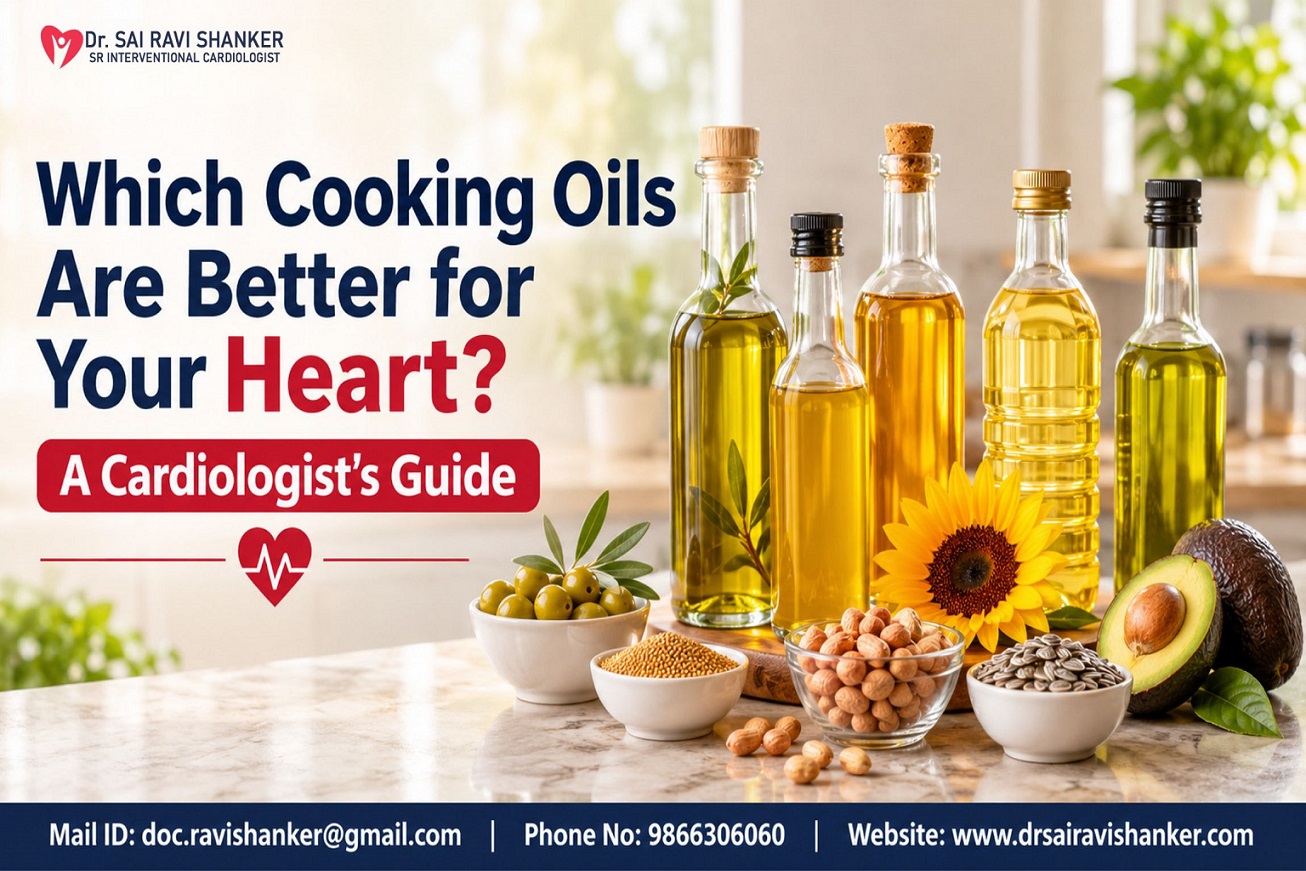
There is no single “best” cooking oil for the heart. The best choices are oils that are low in saturated fat and high in monounsaturated or polyunsaturated fat, such as olive, canola, groundnut (peanut), sesame, rice bran, sunflower and avocado oil. Oils high in saturated fat (coconut, palm, ghee, butter) are better kept to small amounts, and partially hydrogenated oils (vanaspati-type fats) and reused oil are best avoided. Using less oil overall matters as much as choosing the right one.
As a heart specialist in Hyderabad, one of the most common questions we hear in clinic is: “Doctor, which oil should I cook with?” This guide gives you a clear, evidence-based answer.
Why the Type of Fat in Your Oil Matters for Your Heart
All cooking oils are almost entirely fat. What separates one oil from another is the mix of fats it contains:
- Saturated fat: Too much over time can raise LDL (“bad”) cholesterol, which builds up in artery walls and increases the risk of heart attack and stroke.
- Monounsaturated fat: Replacing saturated fat with monounsaturated fat can help improve blood cholesterol levels.
- Polyunsaturated fat: Includes omega-3 and omega-6 fatty acids, which the body cannot make on its own.
- Trans fat: Industrially produced trans fat clogs arteries, raises the risk of heart attacks and has no known health benefits.
A simple rule of thumb: oils that stay liquid at room temperature tend to be higher in unsaturated fats, while fats that turn solid tend to be higher in saturated fat. Heart-health guidance consistently recommends replacing saturated and trans fats with monounsaturated and polyunsaturated fats.
A label check you can do in 10 seconds: choose an oil with less than 4 grams of saturated fat per tablespoon and no partially hydrogenated oil or trans fat listed.
Cooking Oils for Heart Health: Comparison Table
| Group | Oils | What to know |
|---|---|---|
| Better everyday choices | Olive, canola, groundnut (peanut), sesame, rice bran, sunflower, soybean, corn, safflower | Low in saturated fat and higher in unsaturated fat. Generally suitable for everyday cooking. |
| Good specialty options | Avocado, grapeseed, mustard | Avocado and grapeseed can be healthy choices but may cost more. Mustard oil is rich in monounsaturated fat and also provides omega-3. |
| Use sparingly | Coconut oil, palm oil, ghee, butter | Higher in saturated fat. Small portions can fit into a balanced diet, but they should not be the main cooking fat every day. |
| Avoid | Partially hydrogenated oils, vanaspati-type fats, any oil that has been reheated or reused | Source of trans fat and degraded compounds. |
What Does the Research Say About Olive Oil and the Heart?
Olive oil has some of the strongest long-term evidence. A large study followed more than 90,000 adults for 28 years and found that people who consumed more than about half a tablespoon (7 grams) of olive oil a day had a 19% lower risk of dying from cardiovascular disease than people who rarely or never used it.
The same study found that replacing about 10 grams a day of margarine, butter, mayonnaise or dairy fat with olive oil was linked to an 8–34% lower risk of death overall and from specific causes.
Two honest caveats:
- This was an observational study, so it shows an association, not proof of cause. People who use more olive oil may also follow healthier diets overall.
- The study did not find a significant difference when olive oil replaced other vegetable oils. The biggest gain came from swapping out butter, margarine and animal fats.
Takeaway: if you currently cook with butter, margarine or other solid fats, switching to a liquid vegetable oil, including olive oil, is a meaningful step for your heart.
Coconut Oil, Ghee and Palm Oil: Should You Avoid Them?
Coconut oil is about 82% saturated fat, compared with roughly 63% in butter, 50% in beef fat and 39% in lard. In a review of seven controlled trials, coconut oil raised LDL cholesterol in every one, similar to other saturated fats. For that reason, major heart-health guidance advises against using coconut oil as a heart-healthy choice and recommends limiting saturated fat to around 5–6% of daily calories, which is about 13 grams a day on a 2,000-calorie diet.
In practice, we don’t ask patients to give up traditional foods overnight. The goal is balance:
- A spoon of ghee over rice or dal is very different from using ghee as the main cooking fat in every meal.
- A small amount of coconut oil in a traditional dish is different from large amounts of coconut oil, ghee, butter, bakery items and packaged snacks all adding up in the same day.
- If you already have high cholesterol, diabetes or heart disease, ask your cardiologist how much saturated fat is right for you.
Healthy Oils for Indian Cooking: Rotate, Blend and Measure
India’s national dietary guidelines (2024) make three practical points that fit Hyderabad kitchens well:
- No single oil has everything. No one vegetable oil contains all essential fatty acids in the right proportions.
- Blend or rotate. Using a blend of two oils, or rotating oils periodically, helps balance saturated, monounsaturated and polyunsaturated fats. For example, groundnut and mustard oils are rich in monounsaturated fat, while soybean and rice bran oils supply omega-3 and omega-6 fatty acids.
- Quantity counts. For most sedentary adults, the guidelines suggest about 20–30 grams of visible fat per day, which includes cooking oil, ghee and butter.
One tablespoon of any oil contains roughly 120 calories. Even the healthiest oil is energy-dense, so measuring your oil with a spoon instead of pouring freely is one of the easiest heart-healthy habits to build. Using less oil, avoiding repeated deep-frying and eating fewer ultra-processed foods often helps more than switching brands.
Cooking Habits That Matter as Much as the Oil
The oil in the bottle can be perfectly healthy and still become harmful in the pan. Heart-health guidance recommends:
- Never reuse or reheat cooking oil. Repeated heating changes the oil’s chemistry. Studies have found that repeated heating and frying increases trans fat content, even in oil that had none to begin with.
- Stop if it smokes. Oil starts to break down once it reaches its smoke point. Don’t use oil that smokes or smells off.
- Smell before you pour. Oil stored too long can turn rancid. Discard it if it smells bad.
- Store smart. Keep oil in a cool, dark place and buy smaller bottles if you use it slowly.
- Limit deep-frying. Even with a healthy oil, deep-fat frying is not recommended as a regular cooking method. Roasting, grilling, sauteing, steaming and baking are better.
- Be careful with street and restaurant fried food. Oil used repeatedly at high heat can contain high levels of trans fat. Industrially produced trans fat is linked to more than 278,000 deaths worldwide each year, and high intake raises the risk of coronary heart disease by 21% and coronary heart disease deaths by 28%. The recommended limit is less than 1% of daily energy, roughly 2 grams a day.
A 7-Step Heart-Healthy Oil Checklist
- Choose a liquid vegetable oil with less than 4 g of saturated fat per tablespoon.
- Check the label for partially hydrogenated oil or trans fat, and skip it.
- Rotate or blend two suitable oils rather than relying on one forever.
- Measure your oil. Aim for the 20–30 g per day of total visible fat for most sedentary adults.
- Keep coconut oil, ghee, butter and palm oil to small portions.
- Never reheat or reuse cooking oil.
- Pair good oils with a good overall diet: vegetables, whole grains, legumes, nuts and fish, along with regular activity, a healthy weight and no tobacco.
When Should You See a Heart Specialist?
Diet is one part of heart care. Please book a cardiac evaluation if you notice chest discomfort, shortness of breath, unusual fatigue, dizziness or palpitations. People with risk factors such as high blood pressure, high cholesterol, diabetes or a known history of heart disease can also benefit from regular check-ups.
Looking for a Cardiologist in Hyderabad?
If you are searching for a cardiologist near me or a heart specialist in Hyderabad, look at qualifications, experience, area of specialisation, hospital facilities and how clearly the doctor explains your diagnosis and treatment options.
Dr. A. Sai Ravi Shanker is a Senior Consultant and Head of the Department of Cardiology at Aster Prime Hospital, Ameerpet, Hyderabad. He holds MD and DM (Cardiology) qualifications, is a Fellow of the American College of Cardiology (FACC) and a Fellow of the European Society of Cardiology (FESC), and has over 25 years of experience as an interventional cardiologist, with more than 20,000 cath lab procedures performed. His areas of care include hypertension, heart failure, emergency cardiac care and complex coronary and structural heart interventions.
Learn more about our services:
- Cardiology consultation and treatment
- Hypertension and hypertensive crisis
- Heart failure care
- Coronary angiogram
- Acute coronary syndrome
Book an appointment: call +91 98663 06060 or visit the contact page. The practice lists locations in Ameerpet, Banjara Hills, Jubilee Hills, Secunderabad and Begumpet.
Frequently Asked Questions
Which cooking oil is best for the heart?
No single oil is best for everyone. Choose oils low in saturated fat (under 4 g per tablespoon) and high in monounsaturated or polyunsaturated fat, such as olive, canola, groundnut, sesame, rice bran, sunflower or avocado oil. Rotating or blending two oils gives a better balance of fatty acids.
Is olive oil good for the heart?
Yes. Olive oil is rich in monounsaturated fat, and a long-term study linked higher intake to a lower risk of cardiovascular death, especially when it replaced butter, margarine or animal fats. Because the study was observational, it shows association rather than proof.
Is coconut oil bad for the heart?
Coconut oil is about 82% saturated fat and has been shown to raise LDL cholesterol in controlled trials, so it is not considered a heart-healthy choice. Occasional small amounts in traditional dishes are different from using it as your everyday cooking fat. If you have high cholesterol or heart disease, ask your cardiologist.
Is ghee bad for heart patients?
Ghee is high in saturated fat. In small portions, such as a spoonful over rice or dal, it can fit into a balanced diet, but it should not be the main cooking fat. People with high cholesterol or existing heart disease should get personal advice on the right amount.
Is it safe to reuse cooking oil?
No. Heart-health guidance recommends not reusing or reheating cooking oil. Repeated heating degrades oil and can increase trans fat. Discard oil that smokes, smells rancid or looks dark and sticky.
How much oil should I eat per day?
For most sedentary adults, national guidelines suggest about 20–30 grams of visible fat per day, including cooking oil, ghee and butter. One tablespoon of oil is roughly 120 calories, so measuring helps.
Is deep-fried food okay if I use a healthy oil?
Deep-frying is not recommended as a regular cooking method even with healthy oils, and oil should never be reused. Choose roasting, grilling, steaming, baking or sauteing most of the time.
How do I choose the best cardiologist in Hyderabad?
Consider the cardiologist’s qualifications, experience, area of specialisation, hospital facilities and communication style. A good cardiologist will explain your diagnosis, the treatment options, and the expected benefits and risks in plain language.
When should I see a cardiologist?
See a heart specialist if you have chest discomfort, shortness of breath, unusual fatigue, dizziness or palpitations, or if you have risk factors or a known history of heart disease.
